Introducing the AI Architect Roadmap
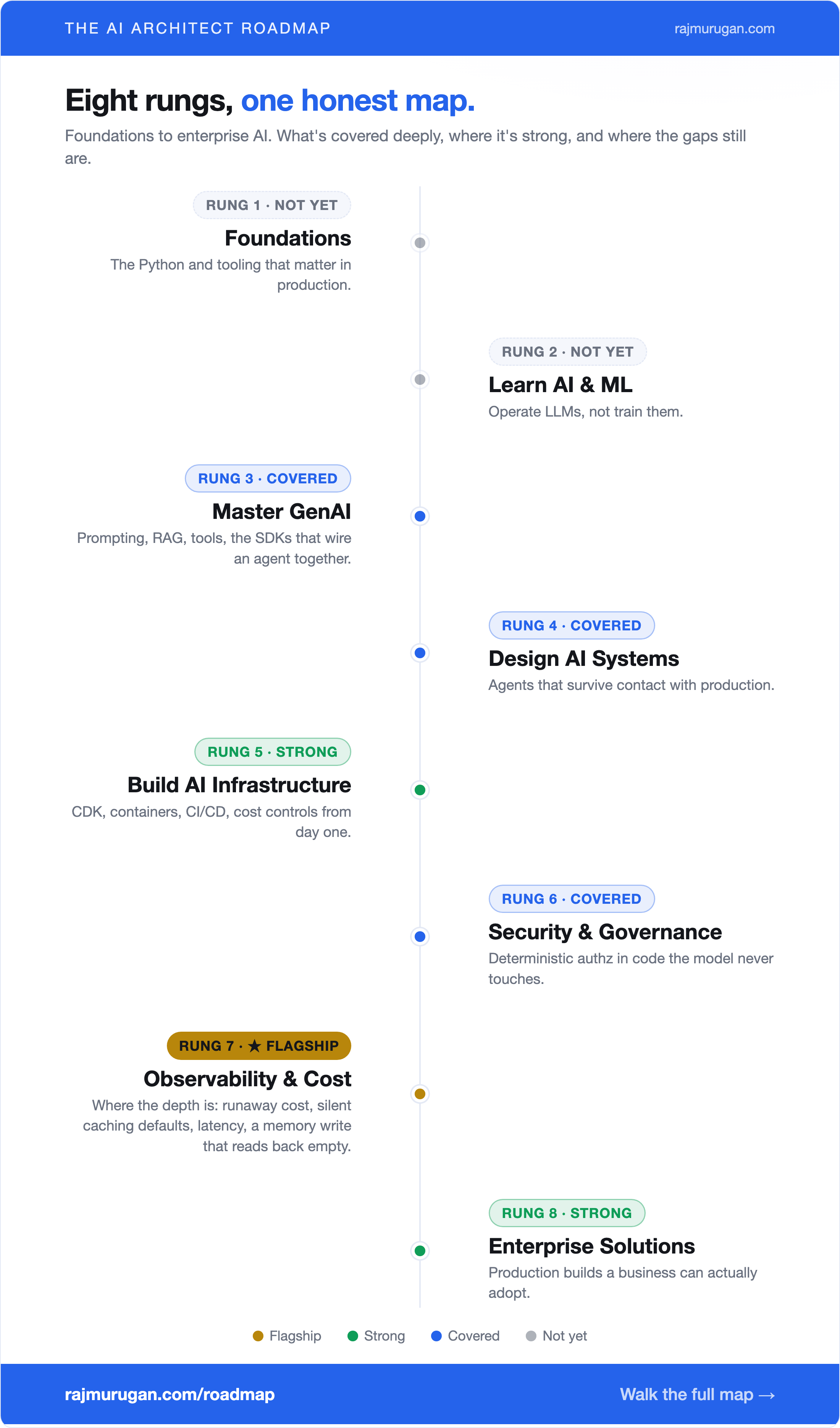
Eight rungs mapping what shipping production Agentic AI on AWS actually takes, marked honestly as covered, strong, flagship or gap rather than filled in to look finished.
On this page
“AI Architect” is one of the vaguest titles in this industry right now. It can mean someone who wired up a chatbot demo in an afternoon, or someone who ships and operates a production Agentic AI system that survives real traffic, a security review, and a finance team asking where the AWS bill went. I got tired of pretending those are the same skill set, so I wrote down what I actually think closes the gap between them, as eight rungs, and put it live at rajmurugan.com/roadmap.
Why a map instead of a course
Most “AI architect learning path” content is a listicle wearing a ladder’s clothes: a dozen tutorial links in a row, sorted roughly by vibes. It reads like progress and teaches like a syllabus nobody finishes. I wanted something closer to an audit than a course: eight rungs, foundations through enterprise delivery, each one marked against what I have actually shipped and written about in production, not what a junior engineer might eventually get around to in theory.
The shape of it
- Foundations: the Python and tooling that matter once code is running an agent loop in production, not an intro course.
- Learn AI & ML: the machine learning an operator needs, not a trainer, tokens, context windows, the knobs that move cost and behaviour.
- Master GenAI: prompting, RAG, tools, the SDKs that wire an agent together on Bedrock.
- Design AI Systems: agents that survive contact with production, intent versus state, a harness that bounds a runaway loop.
- Build AI Infrastructure: CDK, containers, CI/CD with OIDC, cost controls baked in from day one.
- Security & Governance: deterministic authz in code the model never touches, guardrails as a backstop.
- Observability & Cost: where the depth is. More on that below.
- Enterprise Solutions: production builds a business can actually adopt.
Six of the eight were covered by writing here before today, two of those (5 and 8, with 6 close behind) with enough posts behind them that “covered” undersells it. Two were still marked gap, and I mean that literally, not “coming soon” dressed up as done.
Where the depth actually is
Rung 7, Observability and Cost, is the flagship, and it is not close. It is the rung where I have put the most measured, specific writing: an agent that trended toward a six-figure annual run rate while every dashboard stayed green, prompt caching that ships off by default and, in the workload I measured it against, was worth 55 to 78 percent off the recurring system-prefix bill once switched on, an AgentCore Memory write that returned success and, in my own testing, read back empty for up to thirty seconds on the wrong read path (a rough ballpark from a handful of runs, not a published guarantee). None of that is exotic. It is the ordinary way a probabilistic system hides its failures behind metrics built for a deterministic one, and it is the rung I would tell anyone shipping agentic AI on AWS to take most seriously, because it is the one uptime and error-rate dashboards are structurally blind to.
The two rungs marked gap, on purpose
Foundations and ML fundamentals were the two I had not written yet, and I thought about quietly filling them with generic content just so the page would read as finished. Every other “complete path” I have seen does exactly that: pads the early rungs with tutorial-grade material because it is the easiest to write, and it is exactly the material a working engineer already knows and skips past. I would rather the page tell the truth. A gap marked gap is more useful than a gap dressed up as coverage.
That changed today for one of the two. Not a Python tutorial: the patterns that bite in production agents closes rung 1: the senior lens on the Python patterns that actually bite in a production agent loop, not another “hello world” first chapter.
What’s next
Rung 2, the operator’s mental model for the machine learning underneath an LLM, is next. Evals for Production AI, the series that climbed rung 7, is paused at four parts rather than padded with a fifth just to keep the run going. Not promised for a date, because that is the same honesty this roadmap is trying to hold itself to.
Which rung would you actually want filled next?
Related reading
Not a Python tutorial: the patterns that bite in production agents
The senior-lens Python patterns that actually bite in a production agent loop: why boto3 blocking the event loop is the first one, and four more that follow from it.
You probably don't need to fine-tune
A post framed fine-tuning as a 2026 interview trap. Here is the AWS version: the ladder before you touch weights, the four job types and three serving paths Bedrock forks 'fine-tune' into, and what each one costs, priced today.
Your quality alert needs 32 samples
Part 3 left me a label-free signal that responds to a real regression. It does not come with a threshold. Here is where the line actually goes, what a false page costs, and why the reflex answer computes to a negative number.
Newsletter
A new AWS and AI engineering write-up every Tuesday, directly to your inbox.
Also published on dev.to.
Comments
- Loading comments…